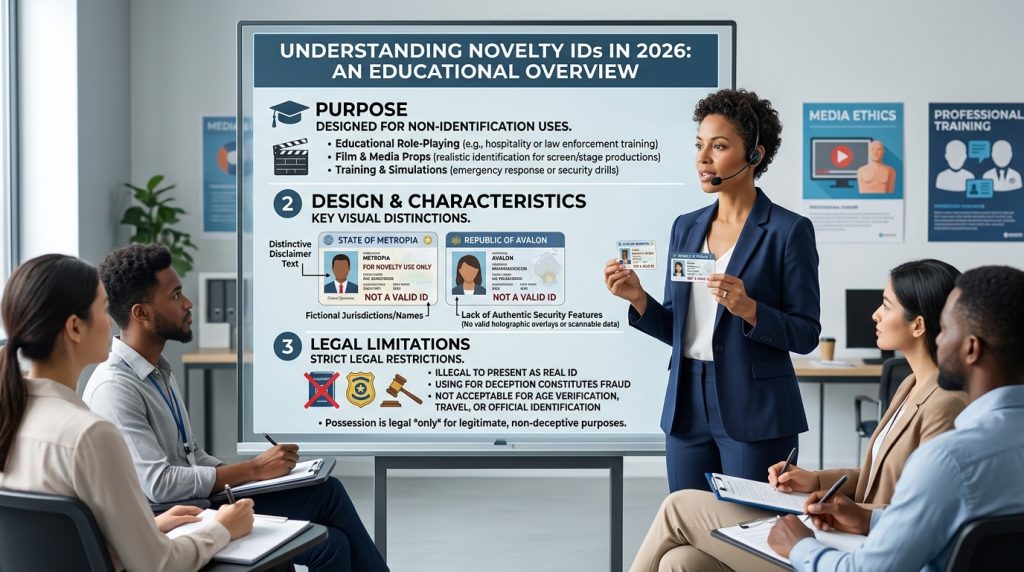
The landscape of identification has undergone significant changes in recent years. While the world increasingly adopts digital wallets and biometric verification, the demand for high-quality physical replicas remains steady within specific professional industries. In 2026, the distinction between official credentials and replicas is more defined than ever, driven by advancements in printing technology and a clearer understanding of their intended use.
Understanding the Nuances
To navigate this industry safely, one must first understand the core comparison of novelty ID vs real ID. A “Real ID” is a government-issued document that meets strict federal security standards, used for official identification, travel, and legal verification. These cards are linked to government databases and contain encrypted security features that cannot be replicated for private use.
In contrast, a novelty ID is a high-fidelity replica designed for non-official purposes. These are not legal identification documents. Instead, they serve as props, educational tools, or collectibles. In 2026, the quality of these items has reached a professional peak, utilizing materials that mimic the “snap” and weight of genuine cards to satisfy the demands of high-definition cinematography and professional training environments.
Professional and Creative Applications
The utility of these replicas extends far beyond simple curiosities. Today, they are essential in several key sectors:
- Film and Media Production: With 8K and 12K cameras becoming the industry standard, “prop” identification must look flawless on screen. Professional sets use these replicas to maintain realism without involving real-world personal data.
- Educational Training: Security firms and retail associations use replicas to train staff on how to handle various card types and recognize different design layouts in a safe, controlled setting.
- Theater and Performance: Live stage productions require durable, realistic-looking items that can withstand the wear and tear of a nightly performance schedule.
Technical Precision and Safety
Manufacturing these items requires a high level of technical expertise. Those who study a novelty ID design guide will find that the process involves sophisticated layering, including micro-printing, ultraviolet (UV) elements, and tactile laser engraving. These features are designed to provide a realistic aesthetic for the user’s specific professional project.
However, safety remains the highest priority. Reputable producers in 2026 ensure that while the cards look impressive, they contain subtle differences or specific markings that clearly distinguish them from government-issued originals. This ensures they remain within the realm of “novelty” and are not misused in high-stakes environments.
Legal Boundaries and Ethical Use
It is crucial to emphasize that novelty IDs are strictly for entertainment, decorative, or educational purposes. They should never be used to misrepresent one’s identity or age. In 2026, responsible use is the industry standard. By utilizing these replicas strictly for their intended creative or training purposes, professionals can benefit from high-quality visual aids while respecting the legal frameworks that protect official identification systems. When used correctly, these items represent a unique intersection of graphic design and practical utility.