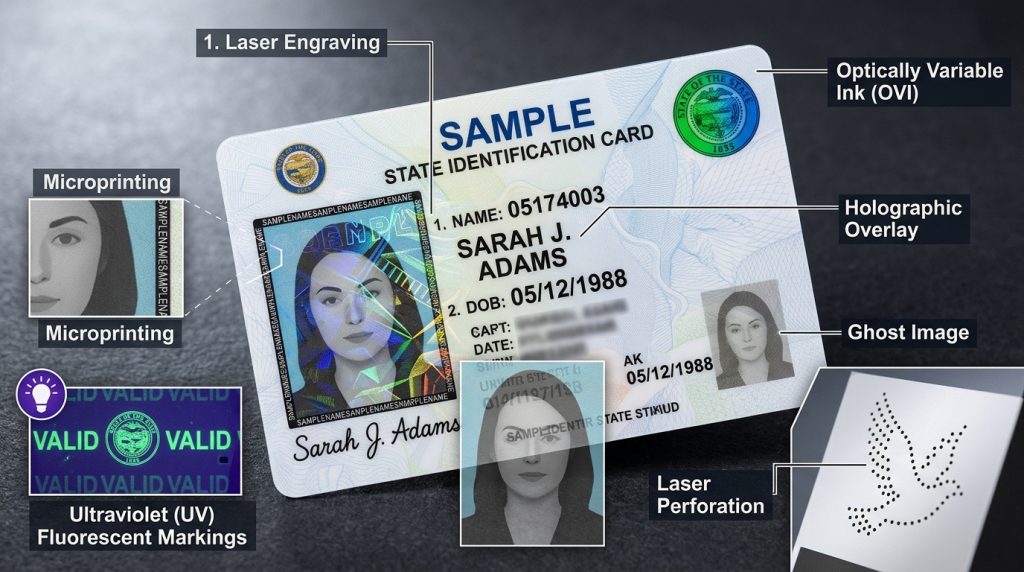
In the modern digital age, the physical security of identification documents has evolved into a high-tech science. Whether you are a business owner verifying credentials or an enthusiast studying document security, the ability to distinguish between basic replications and industrial-grade craftsmanship is a vital skill. To navigate this landscape, one must understand how to identify high-quality ID security features by looking beyond the surface-level aesthetics.
1. The Feel of the Substrate: Polycarbonate vs. PVC
The “human touch” test starts with the material itself. While older or lower-quality cards use simple PVC, high-end security documents utilize Polycarbonate (PC). When you drop a polycarbonate card on a hard surface, it produces a unique metallic “clink” rather than a dull plastic thud.
Furthermore, high-quality documents feature Tactile Laser Engraving. This isn’t just printed text; it is a physical alteration of the card’s surface where lasers have raised the material to create a texture you can feel with your fingertips. If a card is perfectly smooth across all data fields, it likely lacks the security depth of a professional-grade document.
2. Advanced Optically Variable Devices (OVDs)
One of the most complex hurdles for low-quality manufacturers is the replication of OVDs. High-quality security features involve elements that change appearance based on the angle of light:
- Color-Shifting Inks (OVI): Look for a crisp transition between colors (e.g., green to gold). In high-quality versions, the shift is distinct and vibrant, not muddy or static.
- Kinetic Holograms: A professional hologram should show movement or “animation” when tilted. If the hologram looks like a flat, rainbow sticker, it is a clear sign of poor quality.
3. Precision Micro-Printing and Fine Lines
To the naked eye, a document might look perfect. However, a hallmark of professional security is Micro-printing. Using a magnifying glass, you should be able to see tiny, legible text hidden within lines or borders. High-quality printing remains sharp under magnification, whereas low-quality “inkjet” attempts will appear blurry or “pixelated” when viewed closely.
For those interested in the deep-level mechanics of these features, specialized resources like the idgod security education hub offer detailed breakdowns of how these layers are integrated into modern identification standards.
4. Ultraviolet (UV) Response Accuracy
The “Hidden Layer” of a document is its UV response. High-quality documents use “dead” paper or plastic that does not glow blue under a blacklight. Instead, only the specific security symbols or text should fluoresce in bright, multi-colored hues. If the entire card glows bright blue, the material is likely standard consumer-grade plastic rather than a secure substrate.
5. Ghost Images and Windows
Finally, look for Clear Windows and Ghost Images. A high-quality security feature often includes a secondary, semi-transparent version of the portrait embedded within the card structure. In many polycarbonate cards, this ghost image is actually visible from both sides when held up to a light source—a feature that is nearly impossible to replicate without industrial lamination equipment.
Conclusion
Understanding how to identify high-quality ID security features is about recognizing the layers of technology that go into a single document. From the tactile “clink” of polycarbonate to the microscopic precision of laser engraving, these features ensure that a document stands up to professional scrutiny. By focusing on these five pillars, you can confidently assess the quality and authenticity of any modern identification piece.